The NextGen Business Advisory Manual
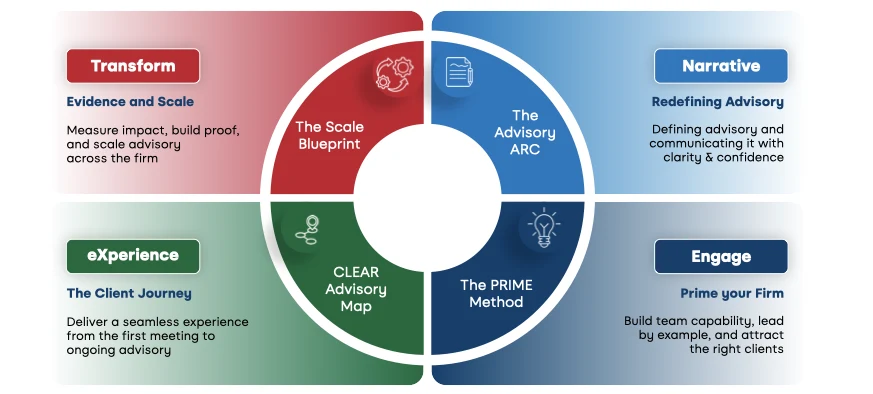
Narrative, Engage, eXperience, Transform. The full system, pillar by pillar.
↓ Download PDFRead as text
The NEXT Gen Advisory System The Complete Internal Playbook Version 5.0 Better Business | Better Life | Better World © Clarity HQ. All rights reserved. NEXT Gen Advisory System © Clarity HQ How to Use This Playbook This playbook is the definitive internal guide to the NEXT Gen Advisory System. It is designed for the Clarity team, licensed partners, and accredited facilitators who deliver the system to accounting firms worldwide. The system addresses four core problems that accountants face when introducing, delivering, and scaling business advisory, and solves them through four integrated pillars that take a firm on a logical journey from defining advisory through to scaling it across the entire firm. The NEXT Gen Advisory System covers the complete advisory journey: how to define, market, price, sell, deliver, and scale business advisory. Each pillar addresses a critical stage of this journey, ensuring nothing is left to chance. The Four Pillars Each pillar contains a named solution with its own stages and sub-frameworks. These are designed to be delivered sequentially, though experienced firms may work across multiple pillars simultaneously. Pillar Theme Solution What It Does Stages N — Narrative Redefining Advisory The Advisory ARC Define advisory and communicate it with clarity and confidence A · R · C E — Engage Prime Your Firm The PRIME Method Build team capability, lead by example, and attract the right clients P · R · I · M · E eX — eXperienc e The Client Journey The CLEAR Advisory Map Deliver a seamless experience from first meeting to ongoing advisory C · L · E · A · R T — Transform Scale & Evidence The Scale Blueprint Scale advisory across the firm with structure, measurement, and sustainability Stage · Structure · Scoreboard · Sustain The Four Problems We Solve The NEXT Gen Advisory System was built to address four core problems that accounting firms face. Each problem maps to one pillar, and each pillar contains a named solution that solves it: Problem 1 “I can’t articulate what advisory actually means — to my team or my clients.” Accountants struggle to define what advisory is, their team cannot explain it consistently, and clients have no idea the firm can help them grow. (Solved by Narrative — The Advisory ARC) Problem 2 “My firm isn’t ready for advisory — and I don’t know how to change that.” Firms lack the team structure, rhythm, shared purpose, leadership credibility, and marketing capability to make advisory work. (Solved by Engage — The PRIME Method) NEXT Gen Advisory System © Clarity HQ Problem 3 “I don’t have a consistent process for winning and delivering advisory that my whole team can follow.” Accountants are uncomfortable selling, clients do not see the value, and there is no repeatable framework for delivery. (Solved by eXperience — The CLEAR Advisory Map) Problem 4 “I can’t scale advisory beyond a few people — it’s a passion project, not a firm-wide capability.” Firms cannot roll advisory out across the firm, prove its impact, or sustain momentum. (Solved by Transform — The Scale Blueprint) NEXT Gen Advisory System © Clarity HQ The NEXT Gen Advisory System Overview This section provides the Announce, Alarm, Aftermath, and Advantage frame for each of the four problems solved by the NEXT Gen Advisory System. Use this when presenting the system on stage, in sales conversations, or in marketing materials. Each problem follows the same four-step pattern: name the skill area, explain the problem, show the consequence, and reveal the solution. Problem 1: The Narrative Problem “I can’t articulate what advisory actually means — to my team or my clients.” Announce: The ability to define and communicate advisory clearly and consistently — both to your team and to your clients. Alarm: Most accounting firms cannot define what advisory actually is. They use vague language like “value-add” and “strategic advice.” Ask ten people in the firm what advisory means and you get eleven different answers. Their clients have no idea the firm can help them grow their business. There is a clarity gap on both sides of the relationship. Aftermath: Without a clear narrative, everything downstream fails. The team cannot sell what they cannot explain. Clients do not buy what they do not understand. Marketing becomes generic. Sales conversations lack confidence. The firm stays trapped in compliance because nobody can articulate a compelling alternative. Advantage: The Advisory ARC solves this through Articulate, Realign, Communicate. It gives every firm a clear, confident definition of advisory (5 I’s), resets expectations with the team and clients (4 R’s), and provides conversation frameworks (4 O’s and HEARO) so every person in the firm can communicate the advisory message with clarity and conviction. It works in two directions: the accountant gets clarity on what to say, and the client gets clarity on what their accountant can do for them. Problem 2: The Engagement Problem “My firm isn’t ready for advisory — and I don’t know how to change that.” Announce: Getting your firm truly ready for advisory — team, leadership, and market. Alarm: Most firms try to launch advisory without doing any of the groundwork. There is no shared purpose, no team structure, no operating rhythm — just enthusiasm and a PowerPoint. The partners asking their team to deliver advisory have never done it themselves. They have never sat in front of a client and run an advisory meeting. The team sees through it every time. And even when the team is ready and the leaders are leading, there is still the question of how to attract the right clients — because the marketing that works for compliance does not work for advisory. Aftermath: Advisory delivery becomes inconsistent. Quality varies from partner to partner. Good people leave because they feel unsupported. The firm’s advisory ambition dies in the gap between what leaders say and what leaders do. Marketing spend is wasted on messages that attract price- sensitive compliance clients rather than growth-minded advisory clients. The firm concludes that “advisory doesn’t work for us” when the real problem is that they were never ready. NEXT Gen Advisory System © Clarity HQ Advantage: The PRIME Method solves this through five integrated stages. Purpose aligns the firm around a shared vision (4 A’s, 4 G’s). Ready builds team capability and operating rhythm (4 M’s, 4 R’s). Inspire requires leaders to go first through the See-Do-Share Leadership Loop — so they speak from experience, not theory. Market attracts the right clients through the MESSAGE System. And Energise keeps the flywheel spinning through collective accountability and continuous measurement. Problem 3: The Experience Problem “I don’t have a consistent process for winning and delivering advisory that my whole team can follow.” Announce: Having a single, repeatable framework for both selling advisory and delivering it — that any team member can follow with confidence. Alarm: Accountants are deeply uncomfortable selling. The word itself triggers resistance. They trained to be professionals, not salespeople. So they hint at advisory, wait for clients to ask, or give so much away for free that there is nothing left to charge for. And even when someone says yes — what then? Every partner delivers advisory differently. There is no common framework, no consistent rhythm, and no standard for what a “good” advisory meeting looks like. Quality depends entirely on who is in the room. Aftermath: There is a gap between winning the work and doing the work, and most firms are stuck in that gap. Advisory revenue stays flat. Partners discount fees because they lack confidence. Client experience varies wildly — some get excellent advisory, others get a vague conversation and a to-do list. Firms cannot scale because delivery is trapped in the heads of a few experienced partners. Advantage: The CLEAR Advisory Map solves this by making the buying experience and the delivery experience the same thing. The first time a client goes through CLEAR (in the Clarity Meeting), they are buying. Every subsequent time, they are deepening. Same framework, same rhythm, different depth. The selling psychology is built into the structure: Current meets them where they are, Leaderboard creates urgency, Endgame paints the future, Actions navigates the decision, and Review sustains the relationship. The accountant never has to “sell” — the process does it for them. Supported by Clarity’s subscription packaging, firms have a clear product menu that makes pricing and scoping consistent. Problem 4: The Scaling Problem “I can’t scale advisory beyond a few people — it’s a passion project, not a firm-wide capability.” Announce: Scaling advisory from a handful of partners to the entire firm — across all clients, all team members, and all service lines. Alarm: Many firms get advisory working with a few clients or one enthusiastic partner, but cannot scale it. It remains a side project. There is no rollout plan, no infrastructure, and no accountability for firm-wide adoption. The managing partner asks “how do we do this for everyone?” and nobody has an answer. Aftermath: Advisory stays trapped as one person’s passion project. It never becomes the firm’s way of working. The return on investment is invisible because there is no measurement system. NEXT Gen Advisory System © Clarity HQ Partners who are not involved become sceptics. And eventually, when the next compliance deadline hits, advisory quietly gets deprioritised. Again. Advantage: The Scale Blueprint solves this with four stages: Stage (5 S’s) provides a deliberate, wave-based rollout plan. Structure (5 P’s) builds the operational infrastructure — people, processes, platforms, programmes, and playbooks. Scoreboard provides OKRs, metrics (5 V’s), and trend observation (3 I’s) to drive accountability. Sustain (4 E’s) embeds advisory into the firm’s DNA so it becomes permanent, not a passing initiative. NEXT Gen Advisory System © Clarity HQ Pillar 1: N — Narrative The Advisory ARC The Advisory ARC gives every firm a clear, confident, and consistent way to define advisory, reset expectations, and communicate what they offer. It is the foundation upon which every other pillar is built. Without a clear narrative, firms cannot engage their teams, attract the right clients, or deliver a meaningful experience. Critically, the Advisory ARC works in two directions. Inward: the accountant gets clear on what they offer, why it matters, and how to talk about it with confidence. Outward: the accountant learns how to shift the client’s perception from “you do my tax” to “you help me grow my business.” The ARC bridges the clarity gap on both sides. The Advisory ARC also underpins a fundamental identity shift. The traditional model positions the accountant as a reporter: someone who presents the numbers and waits. The NEXT Gen model repositions the accountant as a Numbers Mentor: someone who supports through the numbers AND challenges the decisions those numbers reveal. A coach facilitates from the outside. A mentor has been there, has seen the exact problem play out across hundreds of businesses, and shortcuts the journey. That is what an accountant with the right system and the right data can be for a small business owner. ARC stands for Articulate, Realign, Communicate. Each stage has its own sub-framework that provides the tools and language to move from confusion to clarity. The Problem “I can’t articulate what advisory actually means — to my team or my clients.” Accountants struggle to define what advisory actually is. They use vague language, their team cannot explain it consistently, and their clients have no idea the firm can help them improve their business. There is a clarity gap on both sides of the relationship. A — Articulate: What Advisory Is (and Isn’t) The first challenge is getting everyone on the same page about what advisory actually means. This stage provides a structured approach to defining advisory in simple, practical terms that the whole firm can get behind. The 5 I’s The 5 I’s framework walks a firm through five lenses to build a complete and practical definition of advisory: Stage Description Is What advisory IS in plain language. Strip away the jargon. Advisory is helping business owners make better decisions, more often, with better information. Isn’t What advisory is NOT. It is not ad-hoc advice over coffee. It is not a bolt-on to compliance. It is not something only partners can deliver. Included What is included in an advisory engagement. Define the scope so clients and team members understand the boundaries. Integration How advisory integrates with existing compliance, tax, and other services. It NEXT Gen Advisory System © Clarity HQ is not a replacement; it is an enhancement that makes every other service more valuable. Impact The measurable impact advisory delivers. For the client (better business decisions), for the firm (higher revenue per client, deeper relationships), and for the team (more fulfilling work). Key Outputs • One-Page Advisory Definition (firm-specific, plain English) • Internal Talk-Track (so every team member can explain advisory consistently) • Client-Facing Summary (what advisory means for the business owner) R — Realign Expectations Once advisory is defined, the firm needs to reset the expectations of everyone involved: the partners, the team, and the clients. Years of compliance-focused relationships have set expectations that need careful and deliberate realignment. This is where the outward-facing work of the Advisory ARC comes alive — shifting how clients see their accountant. The 4 R’s Stage Description Recognise Acknowledge the current reality. What do clients currently expect from the firm? What does the team believe their role is? Be honest about where you are starting from. Reframe Shift the lens. Help partners see that advisory is not about doing more work, but about changing the nature of the conversation. Help clients see their accountant as a growth partner, not just a compliance provider. Reset Formally reset expectations with clear communication. This is where the firm draws a line and says: this is what we stand for, this is what we offer, and this is how we work with our clients going forward. Reinforce Build reinforcement loops. Expectations drift without consistent reinforcement. Use team meetings, client touchpoints, and marketing to continually reinforce the new positioning. Key Outputs • Expectation Charter (internal document defining the new standard) • Story Bank (collection of real examples and case studies for reinforcement) • Client Communication Templates (for resetting expectations with existing clients) C — Communicate with Clarity Defining advisory and realigning expectations only matters if the firm can communicate the message clearly and consistently. This stage provides the tools and frameworks for every client- facing conversation. NEXT Gen Advisory System © Clarity HQ The 4 O’s The 4 O’s provide a structure for building a clear advisory message: Stage Description Outcomes Lead with outcomes, not services. Clients do not buy advisory; they buy the result of advisory: more cash, more time, more confidence in their decisions. Options Present options, not a single proposal. Give clients a choice of engagement levels so they feel in control and can self-select into the right level of support. Outline Outline the journey, not just the deliverables. Show clients what working with you looks like, month by month, so they can see the value unfolding over time. Offer Make a clear, confident offer. Not a tentative suggestion, but a professional recommendation based on what you have heard and what you believe will create the most impact. The HEARO Conversation Framework HEARO is the conversation framework that underpins every advisory discussion, from the first meeting to ongoing reviews. It ensures the conversation stays client-centred and outcome- focused: Stage Description Hear Listen deeply. Let the client speak. Understand their world before you offer anything. Echo Reflect back what you have heard. This builds trust and confirms understanding. Ask Ask the questions that go deeper. Challenge assumptions. Uncover the real issues. Re-say Summarise and reframe. Present what you have heard in a way that creates clarity for the client. Offer Make your recommendation with confidence. Based on everything you have heard, this is what you believe they need. Key Outputs • Outcome Script Cards (pocket-sized conversation prompts for every team member) • Client One-Pager (the leave-behind document after every advisory conversation) • Universal Opener: “What’s the one thing you want more of — cash, time, or headspace?” NEXT Gen Advisory System © Clarity HQ Pillar 2: E — Engage The PRIME Method The PRIME Method is a unified framework that takes a firm from internal alignment through to external market presence. It covers team capability, leadership credibility, marketing strategy, and sustained momentum in a single integrated system. PRIME stands for Purpose, Ready, Inspire, Market, Energise. It is the engine that primes a firm to deliver advisory before a single client walks through the door. The Problem “My firm isn’t ready for advisory — and I don’t know how to change that.” Firms lack the team structure, rhythm, and shared purpose to deliver advisory consistently. Partners and leaders have not experienced advisory themselves, so cannot model it for their team. Firms do not know how to market advisory services or attract the right clients, talent, or team buy-in. P — Purpose: Align Around Why Every successful advisory firm starts with a shared purpose. Without it, advisory becomes a side project that nobody owns and nobody prioritises. Purpose provides the gravitational pull that keeps the entire firm moving in the same direction. The 4 A’s of Common Purpose The 4 A’s create alignment at the deepest level: Stage Description Align Bring the leadership team together around a shared vision for advisory. Why are we doing this? What does success look like? What are we prepared to change? Articulate Put the purpose into words that everyone can repeat. Not a mission statement on a wall, but a living sentence that every team member can say with conviction. Anchor Connect the purpose to daily actions. Purpose without practical anchors becomes an aspiration that fades. Link it to weekly rhythms, client interactions, and team decisions. Amplify Make the purpose visible and unavoidable. Use it in team meetings, client conversations, and hiring decisions. The purpose should be impossible to ignore. The 4 G’s of Clear Goals Purpose without goals is just enthusiasm. The 4 G’s turn the vision into measurable targets: Stage Description Goals Set specific, time-bound advisory goals. How many clients on advisory within 12 months? What revenue target? What client satisfaction score? NEXT Gen Advisory System © Clarity HQ Generate Generate buy-in by involving the team in goal-setting. People commit to goals they helped create. Guardrails Define the boundaries. What will you say no to? Which clients are not right for advisory? What services are out of scope? Ground Truth Establish the baseline. Where are you today? How many advisory clients do you have now? What is your current revenue per client? Key Outputs • Firm Purpose Statement (one sentence, client-facing and team-facing versions) • Advisory Goals Dashboard (12-month targets with quarterly milestones) • Guardrails Document (what is in scope and what is not) R — Ready: Build Team Capability A firm cannot deliver advisory if its people are not equipped for it. Ready is about building the complementary skills, roles, and operating rhythm that make advisory delivery consistent and scalable. The 4 M’s of Complementary Skills Stage Description Map Map the current skills across the team. Who is strong at client conversations? Who understands financial analysis? Who can facilitate a planning session? Mix Design the right mix. Not everyone needs to be a client-facing advisor. Build teams that combine analytical strength, relationship skills, and delivery capability. Match Match people to roles that play to their strengths. Do not force introverted analysts into client-facing roles. Instead, build delivery models that use everyone’s strengths. Mentor Create mentor pairs and learning pathways. The fastest way to build capability is structured peer learning, not just external training. The 4 R’s of Ways of Working Capability without structure is chaos. The 4 R’s establish the operating rhythm that makes advisory consistent: Stage Description Rhythm Establish a team cadence: daily stand-ups (15 minutes), weekly operations meetings (30 to 45 minutes), Friday numbers pulse, monthly retros, quarterly planning. Rules Define the non-negotiable rules of engagement. Every client gets a review within 30 days. Every advisory meeting follows CLEAR. Every action has an owner and a deadline. Roles Assign clear roles for every advisory engagement. Who leads the meeting? Who prepares the data? Who follows up on actions? Clarity of role prevents duplication and gaps. NEXT Gen Advisory System © Clarity HQ Review Build review loops into every cycle. What worked this week? What did not? What do we do differently next time? Continuous improvement is built in, not bolted on. Standard Cadence Daily Stand-Up: 15 minutes — priorities, blockers, quick wins Weekly WIP/Ops: 30–45 minutes — pipeline, client updates, team needs Friday Numbers Pulse: Key metrics, trends, actions Monthly Retro: What worked, what didn’t, what changes Quarterly Planning: Strategic review, OKR setting, goal refresh Key Outputs • Team Skills Map (visual overview of capabilities and gaps) • Advisory Team Structure (roles, responsibilities, and reporting lines) • Operating Rhythm Calendar (cadence of meetings and reviews) I — Inspire: Lead by Example The single biggest barrier to advisory adoption is that the partners and leaders asking their team to deliver advisory have never done it themselves. Inspire solves this by requiring leaders to go first, build internal proof, and then cascade the approach through the firm. The See-Do-Share Leadership Loop This is the core engine of the Inspire stage. Leaders must See it (experience advisory on their own firm), Do it (deliver it to a pilot client), and then Share what they learned with the team. L1 — Look Inward: The 4 R’s Stage Description Reflect Honestly assess your own effectiveness as a leader. Where are you spending your time? What are you avoiding? What would you tell yourself if you were your own advisor? Review Review your own firm’s numbers as if you were an advisory client. What would you tell yourself? Where are the gaps? Refine Identify the two or three things that would make the biggest difference to your own practice. These become your personal advisory plan. Reset Draw a line. Commit publicly to the changes you are going to make. This vulnerability creates permission for the rest of the team to do the same. L2 — Lead the Work This is where the leader runs their own firm (or a pilot client) through the full CLEAR Advisory Map. The objective is not perfection; it is experience. By doing it themselves, leaders build the empathy, language, and credibility to ask others to do the same. L3 — Leverage Strengths: The 4 S Model Stage Description NEXT Gen Advisory System © Clarity HQ Strengths Identify what each leader and team member does best. Build delivery models that play to these strengths. Structure Redesign responsibilities so that people spend more time in their strengths zone and less time on tasks that drain them. Support Put support systems in place: mentoring, peer coaching, templates, checklists. Nobody should feel they are doing this alone. Stretch Set stretch goals that push people just beyond their comfort zone. Growth happens at the edge, not in the centre. L4 — Land the Message: The 4 C Cadence Stage Description Clarify Make the firm’s advisory purpose and progress clear to every team member, every week. Connect Connect the day-to-day work to the bigger picture. Help people see how their contribution matters. Cascade Cascade the message through every level. Partners tell managers, managers tell team leads, team leads tell their teams. Celebrate Celebrate wins publicly and specifically. Not generic praise, but specific recognition of actions and outcomes. L5 — Learn, Lift, and Lead Others: The 3 E Flywheel Stage Description Example Continue to lead by example. The moment leaders stop doing advisory themselves, the team stops believing it matters. Enable Actively enable others to step up. Create a Growth Ladder: Observer, Doer, Coach, Advisor. Every team member can see their development path. Expand Expand the circle. As more people gain experience and confidence, the firm’s advisory capacity grows organically. Key Outputs • Personal Leadership Dashboard (L1 self-assessment) • Proof of Concept Pack (L2 internal case study) • Growth Ladder (team development pathway: Observer → Doer → Coach → Advisor) • Communication Board (visible dashboard tracking purpose, progress, and priorities) M — Market: Attract the Right Clients With the firm’s team aligned, capable, and led by example, it is time to turn the focus outward. Market is about building a systematic, repeatable approach to attracting the right advisory clients. This is not about generic marketing; it is about positioning the firm as the obvious choice for business owners who want better outcomes. NEXT Gen Advisory System © Clarity HQ The MESSAGE System MESSAGE is a seven-stage marketing rhythm that builds the firm’s visibility and pipeline: M1 — Map Your Market: The 4 P’s Stage Description Purpose Define the purpose of your marketing. What do you want to be known for? What type of client do you want to attract? People Identify your ideal client avatar. Industry, size, stage of business, mindset. Be specific. The more focused you are, the more magnetic your message becomes. Problems Understand the specific problems your ideal clients face. Not generic business challenges, but the real, emotional pain points that keep them awake at night. Proof Gather proof that you can solve these problems. Case studies, testimonials, data points, before-and-after stories. E2 — Establish Your Edge: The 3 V’s Stage Description Value Define your unique value proposition. Not “we provide advisory services”, but a specific, compelling statement of the transformation you deliver. Vehicle Identify the vehicle for delivering that value. Is it the CLEAR framework? Is it industry-specific expertise? Is it a proprietary data platform? Voice Develop your firm’s voice. Are you authoritative and professional? Warm and approachable? Challenging and provocative? The voice must be authentic and consistent. S3 — Shape Your Story: The 3 A’s Stage Description Audience Write for your audience, not for yourself. Every piece of content should speak to the client’s world, not the firm’s capabilities. Adviser Position the adviser as the guide, not the hero. The client is the hero of their own story. The adviser is the expert guide who helps them reach their destination. Arc Every piece of content should follow a story arc: the challenge (where they are), the journey (what needs to change), and the outcome (where they could be). S4 — Systemise Your Funnel: The 4 C’s Stage Description Content Create a content engine that produces regular, valuable content: articles, videos, guides, case studies. Consistency matters more than perfection. Community Build a community of prospective and current clients. LinkedIn groups, email lists, local networks. People buy from people they know and trust. Conversion Event Design a signature event that bridges awareness and engagement: the Business Improvement Summit. This is the key conversion point in the NEXT Gen Advisory System © Clarity HQ funnel. Clarity Meeting The Clarity Meeting is the final step in the funnel. It is not a sales meeting; it is the first advisory experience, delivered through the CLEAR framework. A5 — Activate Your Audience: The 5 C’s Stage Description Calendar Plan your marketing activity 90 days ahead. Block time in the calendar, assign responsibilities, and treat marketing with the same discipline as client work. Channels Choose two or three channels and do them well. LinkedIn, email, and events are the most effective channels for advisory firms. Cadence Publish consistently. Weekly content, monthly events, quarterly summits. Cadence builds familiarity and trust. Content Create content that educates, not sells. Share insights, frameworks, and stories. Position the firm as a thought leader, not a salesperson. Call to Action Every piece of content needs a clear next step. Register for the summit. Book a Clarity Meeting. Download the guide. Never leave the audience without a path forward. G6 — Grow Through Events: The 4 E’s Stage Description Educate Every event should teach something valuable. Attendees should leave smarter than they arrived, regardless of whether they become clients. Engage Create interactive moments. Workshops, Q&A sessions, peer discussions. Engagement builds connection. Elevate Use events to elevate the firm’s profile and the attendees’ thinking. Challenge their assumptions and show them a better way. Extend Follow up within 48 hours. Extend the conversation from the event into a one-to-one Clarity Meeting invitation. E7 — Evaluate and Expand: The 3 M’s Stage Description Metrics Track the numbers that matter: website traffic, email open rates, event attendance, Clarity Meeting bookings, conversion rates. Momentum Identify what is creating momentum and do more of it. Double down on the channels and messages that are working. Multiply Scale what works. Turn successful events into repeatable formats. Turn popular content into evergreen assets. Build systems that multiply effort. Key Outputs • Ideal Client Avatar (detailed profile with demographics, psychographics, and pain points) • Value Proposition Statement (one sentence that captures the firm’s unique advisory value) • 90-Day Marketing Calendar (planned activities with owners and deadlines) • Business Improvement Summit Format (repeatable event template) NEXT Gen Advisory System © Clarity HQ • Mapped Sales Funnel (every step from awareness to Clarity Meeting with conversion targets) E — Energise: Keep the Flywheel Spinning The final stage of PRIME is about maintaining momentum. Without deliberate energy, even the best-prepared firms lose steam. Energise combines collective accountability, continuous measurement, and the discipline of evaluation to keep the advisory engine running. The 4 R’s of Collective Accountability Stage Description Results Focus on results, not activity. Measure what was achieved, not what was attempted. Review Review performance regularly as a team. Weekly huddles, monthly reviews, quarterly deep dives. Make accountability a rhythm, not an event. Respectful Challenge Create a culture where people can challenge each other constructively. If something is not working, it needs to be said — respectfully, directly, and without blame. Recovery When things go wrong (and they will), recover quickly. Acknowledge, adjust, and move on. A culture of recovery is more powerful than a culture of perfection. The 5 M’s of Continuous Measurement Stage Description Measures Define the measures that matter for the Engage pillar: team engagement scores, skills development progress, marketing pipeline, and client acquisition rates. Monitor Monitor these measures weekly. Not monthly, not quarterly. Weekly visibility drives weekly action. Moments Capture the moments that matter: a team member’s first solo advisory meeting, a client’s breakthrough, a marketing campaign that converted. Mobilise When the data shows something needs attention, mobilise quickly. Do not wait for the next scheduled review. Act now. Magnify Magnify success. Share wins across the firm. When one team achieves something great, make sure everyone knows about it. Key Outputs • Weekly Engage Scorecard (team, leadership, and marketing metrics) • Monthly Momentum Report (what is working, what needs attention, what to change) • Quarterly Energy Audit (is the firm’s advisory momentum growing or fading?) NEXT Gen Advisory System © Clarity HQ Pillar 3: eX — eXperience The CLEAR Advisory Map The CLEAR Advisory Map is the centrepiece of the entire NEXT Gen Advisory System. It provides the repeatable structure for every client interaction, from the very first Clarity Meeting through to ongoing advisory reviews. The critical insight is this: the client buying experience and the advisory delivery experience are not two separate things. They are the same journey, experienced at different depths. The first time a client goes through CLEAR (in the Clarity Meeting), they are buying. Every subsequent time, they are deepening. Same framework, same rhythm, different depth. CLEAR stands for Current, Leaderboard, Endgame, Actions, Review. Each stage has sub- frameworks for both the engagement context (first meeting) and the ongoing delivery context. The Problem “I don’t have a consistent process for winning and delivering advisory that my whole team can follow.” Accountants are uncomfortable selling and clients do not understand the value of advisory. Firms lack a repeatable structure for delivering advisory meetings and engagements. There is a gap between winning the work and doing the work. C — Current: Meet Them Where They Are Every advisory interaction begins by understanding where the client is right now. In the Clarity Meeting context, this is where the client’s current reality is established using the 7 Key Numbers. In ongoing advisory, this is where progress is reviewed and the current position is verified against benchmarks. The 3 V’s (Ongoing Advisory Context) Stage Description Verify Review the 7 Key Numbers using the Clarity Platform and Numina (Clarity’s AI advisory assistant for accountants, see Section 7 of the Positioning and Messaging Playbook for full capabilities). Verify the data, check for anomalies, and establish where the client is right now. Visualise Present the data visually. Charts, dashboards, and comparisons that make the numbers meaningful and accessible to business owners who are not accountants. Voice Give the client a voice. Ask them to share their perspective on where they are currently. What are they seeing in the business? What feels different since the last review? Engagement Sub-Frameworks (Clarity Meeting Context) When CLEAR is used as the buying experience in the Clarity Meeting, the Current stage draws on two additional frameworks to fully understand the client’s starting point: The 5 B’s: Understand Their Current Reality NEXT Gen Advisory System © Clarity HQ Stage Description Beliefs Understand what the client believes about their business, their market, and their potential. Beliefs drive behaviour. Biases Identify the biases that may be distorting their view. Optimism bias, sunk cost bias, recency bias. Gently surface these without judgement. Blockers Uncover what is genuinely blocking progress. Not symptoms, but root causes. Behaviours Observe the behaviours that are keeping them stuck. A business owner who checks every email personally has a delegation problem, not a time problem. Breakthrough Identify the potential breakthrough. What is the one thing that, if it changed, would change everything else? This becomes the advisory focus. The 4 Q’s: Understand Their Needs Stage Description Qualify Qualify the opportunity. Is this client the right fit for advisory? Do they have the willingness, the ability, and the commitment to change? Question Ask the deep questions. Not surface-level questions about revenue and profit, but questions about ambition, fear, legacy, and what they really want from their business. Quantify Put numbers to the opportunity. What is the cost of doing nothing? What is the value of making the change? Quicken Create urgency. Not artificial pressure, but a genuine recognition that delay has a cost. Every month of inaction is a month of missed potential. Key Outputs • Client Snapshot (current position summary from Clarity Platform) • Needs Discovery Notes (from HEARO conversation framework) • 7 Key Numbers Dashboard (verified, visualised, voiced) L — Leaderboard: Show Them Where They Stand The Leaderboard stage creates context through comparison. It is one thing to know your revenue; it is another to know how that compares to thousands of similar firms. This stage uses benchmarking to create both motivation and credibility. The 3 B’s (Core Framework) Stage Description Benchmark Compare the client’s performance against relevant peers using the Clarity Platform’s benchmarking data. Industry, size, region, and stage. Bridge Identify the bridge between where they are and where they could be. Quantify the gap. Show them the distance and make it feel achievable. Boost Build confidence and motivation. The Leaderboard is not about making NEXT Gen Advisory System © Clarity HQ clients feel bad; it is about showing them what is possible and that others like them have closed the gap. Engagement Context: The 3 C’s (Yield the Consequences) In the Clarity Meeting, the Leaderboard stage also incorporates the Yield framework, which makes the consequences of inaction tangible: Stage Description Cost Calculate the financial cost of staying where they are. If the gap is visible, quantify what it is costing them every month. Consequences Explore the broader consequences: team burnout, missed opportunities, competitive risk, lifestyle impact. Make it personal, not just financial. Credibility Use the benchmarking data to build credibility. This is not opinion; this is evidence from thousands of similar businesses. Key Outputs • Benchmarking Report (client position vs. peer group) • Gap Analysis Summary (current vs. potential, quantified) • Consequence Calculator (cost of inaction, personalised) E — Endgame: Paint the Future The Endgame stage shifts the conversation from where the client is to where they could be. It is the most aspirational and motivational stage of CLEAR, connecting business performance to personal goals and life outcomes. The 4 G’s (Core Framework) Stage Description Gaps Identify the specific gaps between current and desired performance. Use the 5 Levers of Success (Revenue Growth, Gross Profit %, Operating Profit %, Revenue per Employee, and Cash Days) through sensitivity analysis. These are the five of the 7 Key Numbers that can be actively moved as levers. The remaining two (Core Cash Target and Business Return) provide the context and destination. Goals Help the client set meaningful goals. Not just financial targets, but personal goals: more time with family, less stress, a business that works without them. Growth Path Map the growth path from current state to goal state. What needs to happen in the next 90 days? The next 12 months? Make it tangible and time-bound. Gain Connect the business gains to personal gains. If the business improves, what does that mean for the owner’s life? This is where advisory becomes truly valuable. Engagement Context: The 4 P’s (Illustrate the Value) In the Clarity Meeting, the Endgame stage draws on the Illustrate framework to make the value proposition tangible: NEXT Gen Advisory System © Clarity HQ Stage Description Proof Show proof that the approach works. Case studies, testimonials, before-and- after examples from similar clients. Picture Paint a vivid picture of what their business and life could look like. Help them see it, feel it, and want it. Process Walk them through the process. Show them exactly what working with you looks like: the meetings, the rhythm, the tools, the support. Position Position the advisory engagement as an investment, not a cost. Frame the fees in the context of the value delivered and the gap closed. Key Outputs • Opportunity Map (5 Levers analysis with quantified upside) • Client Vision Document (business and personal goals, connected) • 12-Month Growth Path (quarterly milestones with measurable targets) A — Actions: Decide, Commit, Move Actions is where insight becomes execution. In the Clarity Meeting, this is where the client decides to engage. In ongoing advisory, this is where priorities are set and progress is planned. The 5 D’s (Core Framework) Actions operates in two phases. Phase 1 — Quick Actions: identified during the Clarity Meeting itself, these are immediate, high-impact steps the client can take within the first week. Phase 2 — Detailed Planning: developed in months one and two, resulting in a comprehensive 90-day action plan with clear milestones. Stage Description Decide Help the client decide on their priorities. Not everything can be tackled at once. Use the data from Current, Leaderboard, and Endgame to identify the highest-impact actions. Design Design the action plan together. Co-creation builds commitment. The client should feel ownership of the plan. Document Document every action with clear ownership, timelines, and success measures. Use the Clarity Platform to track and manage progress. Do Execute. This is where the rubber hits the road. Support the client in taking the first steps, and build early momentum through quick wins. Diagnose Continuously diagnose what is working and what is not. Adjust the plan based on real-world feedback. Advisory is iterative, not linear. Engagement Context: The Decision Frameworks In the Clarity Meeting, the Actions stage incorporates two frameworks that help the client navigate the decision to engage: The 4 F’s: Navigate the Decision NEXT Gen Advisory System © Clarity HQ Stage Description Fit Confirm the fit. Is this the right engagement for this client? Both parties should feel confident. Fears Surface and address fears. Fear of cost, fear of commitment, fear of change. Acknowledge them openly and address them directly. Flow Walk through the flow of the engagement. First meeting, then what? Remove ambiguity about the journey ahead. Future Paint the future. What does the client’s life and business look like in 12 months if they commit today? The 3 C’s: Gain Agreement and Give Care Stage Description Commit Ask for the commitment. Not aggressively, but confidently. Based on everything discussed, here is what I recommend. Clarity Ensure complete clarity on what happens next. The engagement summary, the first meeting date, the investment, and the expected outcomes. Care Begin the care process immediately. A welcome pack, a follow-up call within 48 hours, and a clear onboarding sequence. The experience starts the moment they say yes. Packaging and Pricing: Subscription Advisory Services A critical element of the Actions stage is presenting a clear, structured set of advisory packages. Clarity provides six subscription tiers that give firms a ready-made product menu. This removes the guesswork from pricing and gives clients a clear choice that aligns with their needs and ambition. Package From (pcm) What’s Included Business Diagnostic £97 Clarity 7 Key Numbers Action Plan session (six-monthly). Benchmarking and analysis using Clarity. Approx 2 hours per annum. Quarterly Accountability £197 Everything in Business Diagnostic plus quarterly Clarity Accountability call/zoom (up to 1 hour). Approx 4 hours per annum. Monthly Accountability £347 Everything above plus monthly Clarity Accountability call/zoom (up to 1 hour), budget, cashflow sense check and 7 Key Numbers plan using Clarity. Approx 12 hours per annum. Quarterly Planning £457 Everything above plus quarterly budget, cashflow and KPI tracking included in meetings. Approx 20 hours per annum. Monthly Planning £997 Everything above plus monthly budget, cashflow and KPI tracking, preparation of additional management reporting, detailed cashflow projections, and KPI dashboards. Approx 25 hours per annum. Business Success £1,500+ Everything above plus bespoke business advice, coaching, and consulting using Clarity hi-impact systems. Approx 30+ hours per annum. NEXT Gen Advisory System © Clarity HQ These packages are presented during the Actions stage of the Clarity Meeting, after the client has seen their Current position, understood their Leaderboard ranking, and visualised their Endgame. By this point, the value conversation has already happened — the packages simply give the client a clear way to say yes at the level that is right for them. The 4 O’s from the Advisory ARC’s Communicate stage (Outcomes, Options, Outline, Offer) directly apply here: lead with outcomes, present options (the six packages), outline the journey for each level, and make a confident recommendation based on what you have heard. For conversion and results data (including diagnostic-to-ongoing conversion rates, time savings, and profitability benchmarks), refer to Section 13 of the Clarity Positioning and Messaging Playbook. This is the single source of truth for all proof points and should be referenced rather than duplicated to prevent numbers drifting between documents. Key Outputs • Quick Actions List (from Clarity Meeting) • 90-Day Action Plan (detailed, with ownership and timelines) • Client Engagement Agreement (clear, professional, confidence-building) • Welcome Pack (onboarding materials, first meeting preparation) • Subscription Package Selection (client chooses their level of advisory engagement) R — Review: Sustain, Adjust, Grow Review is what makes advisory ongoing rather than a one-off event. It establishes the rhythm of accountability, progress tracking, and continuous improvement that keeps clients engaged and growing. The 3 H’s (Core Framework) The Review stage creates a continuous loop back to Current, creating the ongoing advisory rhythm: Stage Description Habits Build advisory habits into the client’s business rhythm. Monthly reviews, quarterly planning sessions, annual strategy days. Make advisory a habit, not an event. Hurdles Proactively identify and address hurdles. What is getting in the way of progress? What has changed since the last review? Stay ahead of problems. Hygiene Maintain data hygiene. Ensure the numbers are up to date, the benchmarks are current, and the action plan is relevant. Stale data erodes trust. The Advisory Rhythm Monthly: Review progress, update numbers, adjust actions (60–90 minute meeting) Quarterly: Deep dive into strategy, reset priorities, update the growth path Annually: Comprehensive review, celebrate progress, set next year’s vision The science of accountability underpins the Review stage. Research from the American Society of Training and Development shows that goal achievement rises from 10% (having an idea) to 95% (having a specific accountability review). The University of California found that people with NEXT Gen Advisory System © Clarity HQ written goals and regular accountability achieve 78% more. These findings are the evidence base for why the CLEAR review rhythm works. For the full citations and supporting data, refer to Section 13 of the Clarity Positioning and Messaging Playbook. Hartley: Extending Advisory Between Meetings Hartley is the client-facing AI advisory assistant built into the Clarity platform (askhartley.ai). It extends the advisory conversation into the client’s daily life, available whenever the client needs it, not just during scheduled meetings. Connected to the client’s real financial data via Xero, QuickBooks Online, Sage Online, or manual entry, Hartley answers questions grounded in the client’s actual numbers. It is not a generic AI tool. It is built on the same 7 Key Numbers, 5 Levers, and CLEAR methodology that powers the Clarity platform. Critically, Hartley knows when the accountant needs to be in the room: when a question is too complex or requires a human conversation, Hartley escalates to the right person in the firm by name. For positioning purposes, Numina and Hartley serve distinct roles and must never be conflated. Numina is the AI advisory assistant for accountants: it does the preparation so the accountant can focus on the conversation. Hartley is the AI advisory assistant for clients: it extends that conversation into the client’s daily life. For the full positioning framework for both products, refer to Section 7 of the Clarity Positioning and Messaging Playbook. Key Outputs • Monthly Review Summary (progress, adjustments, next steps) • Quarterly Planning Document (updated 90-day plan with refreshed priorities) • Annual Impact Report (year-in-review showing transformation achieved) • Hartley AI advisory assistant (client-facing extension of CLEAR between meetings) NEXT Gen Advisory System © Clarity HQ Pillar 4: T — Transform The Scale Blueprint The Scale Blueprint provides the structure, measurement, and sustainability framework that allows a firm to scale advisory from a handful of partners to the entire firm. It answers the question every managing partner asks: how do I roll this out across all our clients and all our team members? Unlike the other pillars which focus on capability and delivery, Transform is about organisational change. It is the difference between advisory being one partner’s passion project and advisory being the firm’s way of working. The Scale Blueprint has four stages: Stage, Structure, Scoreboard, Sustain. Each builds on the last, creating a scaling system that is deliberate, measurable, and permanent. The Problem “I can’t scale advisory beyond a few people — it’s a passion project, not a firm-wide capability.” Firms cannot scale advisory beyond a handful of partners or prove its impact to justify further investment. Advisory stays trapped as a side project because there is no blueprint for making it the firm’s operating model. Stage: Decide What to Scale First The first mistake firms make with scaling is trying to do everything at once. Stage is about choosing where to begin — which services, which clients, which team members, and in what order. A deliberate staging plan prevents overwhelm and builds early proof that the model works. The 5 S’s of Staging Stage Description Scan Scan the firm to understand the current state of advisory adoption. Which partners are active? Which teams have capacity? Which clients are ready? Build an honest picture of where you are. Select Select the first wave. Choose the partners, teams, and client segments that will pilot the scale. Prioritise those with the highest readiness and the greatest potential for visible success. Sequence Define the sequence of rollout. Not everything happens at once. Map out waves: Wave 1 (pilot), Wave 2 (early adopters), Wave 3 (firm-wide). Each wave builds on the proof from the last. Scope Set the scope for each wave. How many clients? Which services? What level of advisory (e.g., CLEAR meetings only, or full advisory engagements)? Clarity of scope prevents scope creep. Success Criteria Define what success looks like for each wave before it begins. What metrics will tell you it is working? What signals will tell you to expand, adjust, or pause? NEXT Gen Advisory System © Clarity HQ Key Outputs • Advisory Readiness Audit (firm-wide assessment of current adoption) • Wave Plan (three-wave rollout with timelines and team assignments) • Success Criteria Document (measurable targets for each wave) Structure: Build the Operational Infrastructure Scaling requires infrastructure that most firms do not have. Structure is about building the operational foundation — the training, processes, technology, and team design — that makes advisory delivery consistent regardless of who delivers it. The 5 P’s of Structure Stage Description People Identify who will deliver advisory at scale. Map roles: lead advisors, support team, data analysts, client managers. Not everyone delivers — but everyone has a role in the advisory model. Process Document every repeatable process. Client onboarding, CLEAR meeting preparation, data review, action plan creation, review cadence. If it is not documented, it cannot be scaled. Platform Ensure the technology platform is configured for scale. The Clarity Platform provides the advisory engine, Numina AI handles preparation and analysis for the accountant (see Section 7 of the Clarity Positioning and Messaging Playbook for full capabilities), and Hartley extends advisory to clients between meetings, making advisory available beyond the partner’s calendar. Configure dashboards for every team, automated data feeds, client portals, and reporting templates. Programmes Build training programmes for each wave. Not one-off workshops, but structured learning journeys: observation, shadow delivery, co-delivery, solo delivery with coaching. Playbooks Create delivery playbooks for every stage of CLEAR and every type of advisory engagement. These are the operational manuals that ensure consistency at scale. Key Outputs • Advisory Role Matrix (who does what at each stage of delivery) • Process Library (documented, repeatable processes for every advisory activity) • Training Programme (structured learning journey from observer to lead advisor) • Delivery Playbooks (step-by-step guides for each CLEAR stage) Scoreboard: Measure the Scale You cannot scale what you cannot measure. The Scoreboard provides the OKRs, metrics, and visibility that drive accountability across the firm. It answers three questions: Are we scaling? Is it working? Where do we need to adjust? NEXT Gen Advisory System © Clarity HQ The 5 V’s of Selecting Metrics Stage Description Vision Start with the firm’s vision. What are you trying to achieve? The metrics you select must directly connect to this vision, not just measure activity. Value Measure value, not just volume. Not how many advisory meetings were held, but what outcomes were achieved. Not how many clients are on advisory, but what transformation they experienced. Vital Few Choose the vital few metrics, not the trivial many. Seven to ten core metrics is the target. Each metric should be a leading or lagging indicator of advisory success. Viewpoints Include multiple viewpoints: client outcomes (their business improved), firm performance (revenue, profit, utilisation), team development (skills, confidence, capacity), and adoption (how many teams, partners, and clients are active). Visibility Make the metrics visible. If the team cannot see the numbers, the numbers do not exist. Dashboards, screens, weekly reports. Visibility drives behaviour. OKRs for Scaling The Scoreboard uses OKRs (Objectives and Key Results) as the primary mechanism for driving scaling progress: Stage Description Objectives Set two to three firm-wide objectives per quarter. These should be ambitious, qualitative, and inspiring. Not “increase revenue” but “make advisory the way our best clients experience our firm.” Key Results Define two to four measurable key results for each objective. These are the quantitative evidence that the objective is being achieved. Ownership Assign clear ownership for every key result. One person, not a committee. That person is accountable for progress and for raising blockers early. Operating Rhythm Embed OKRs into the operating rhythm. Review progress weekly, deep dive monthly, reset quarterly. OKRs without rhythm become wallpaper. The 3 I’s of Observing Trends Stage Description Inspect Review the data weekly. Not a glance, but a deliberate, structured review. What has changed? What is trending? What needs attention? Interpret Interpret the trends. A dip in advisory meetings booked might mean the pipeline is soft, or the marketing message has drifted, or the team is overwhelmed. Dig deeper. Inspire Use the data to inspire action. Share the three most important insights from the weekly review with the whole team. Data should motivate, not just inform. Key Outputs NEXT Gen Advisory System © Clarity HQ • Advisory Scorecard (seven to ten core metrics with definitions and targets) • Quarterly OKR Document (two to three objectives with key results) • Weekly Trend Brief (three insights, three actions, three owners) • Monthly Impact Report (performance data, progress trends, proof stories) • Live Dashboard (connected, automated, refreshed weekly) Sustain: Make It Permanent The final stage of the Scale Blueprint is about ensuring advisory does not fade. Many firms scale successfully in year one only to see it erode in year two when attention shifts. Sustain builds the habits, culture, and evidence loops that make advisory the firm’s permanent way of working. The 4 E’s of Sustainability Stage Description Embed Embed advisory into every firm process: hiring criteria, performance reviews, client onboarding, partner meetings. When advisory is woven into the fabric of the firm, it cannot be unpicked. Evidence Continuously gather evidence that advisory is working. Client impact stories, firm performance data, team satisfaction scores. Evidence builds the case for continued investment and silences sceptics. Evolve The advisory model must evolve. Markets change, client needs shift, technology advances. Build a quarterly review cycle that asks: is our advisory offering still relevant? What needs to change? Expand Once the model is proven and sustained, expand into new areas: new client segments, new service lines, new geographies. The Scale Blueprint becomes the template for repeated scaling. The 3 P’s of Evidence Stage Description Performance Quantify the firm’s advisory performance. Revenue per advisory client, advisory as a percentage of total revenue, client retention rates, average engagement length. Progress Track progress over time. Month-on-month, quarter-on-quarter, year-on- year. Show the trajectory, not just the snapshot. Trajectory tells the real story. Proof Capture the proof stories. For every data point, there is a human story. The manufacturing client who freed up 15 hours a week. The family business that tripled their valuation. These stories are the most powerful evidence of all. Key Outputs • Advisory Integration Checklist (every firm process that should reference advisory) • Client Impact Library (collection of evidence stories, data points, and case studies) • Quarterly Evolution Review (is the model still fit for purpose?) • Expansion Playbook (how to replicate the Scale Blueprint in new areas) NEXT Gen Advisory System © Clarity HQ • Annual Advisory Report (comprehensive year-in-review for the whole firm)